
I often get asked, what is the gap that Switch Thinking fills?
And further, how does Switch Thinking compare with other approaches to creativity, change and performance.
What makes it different, people ask?
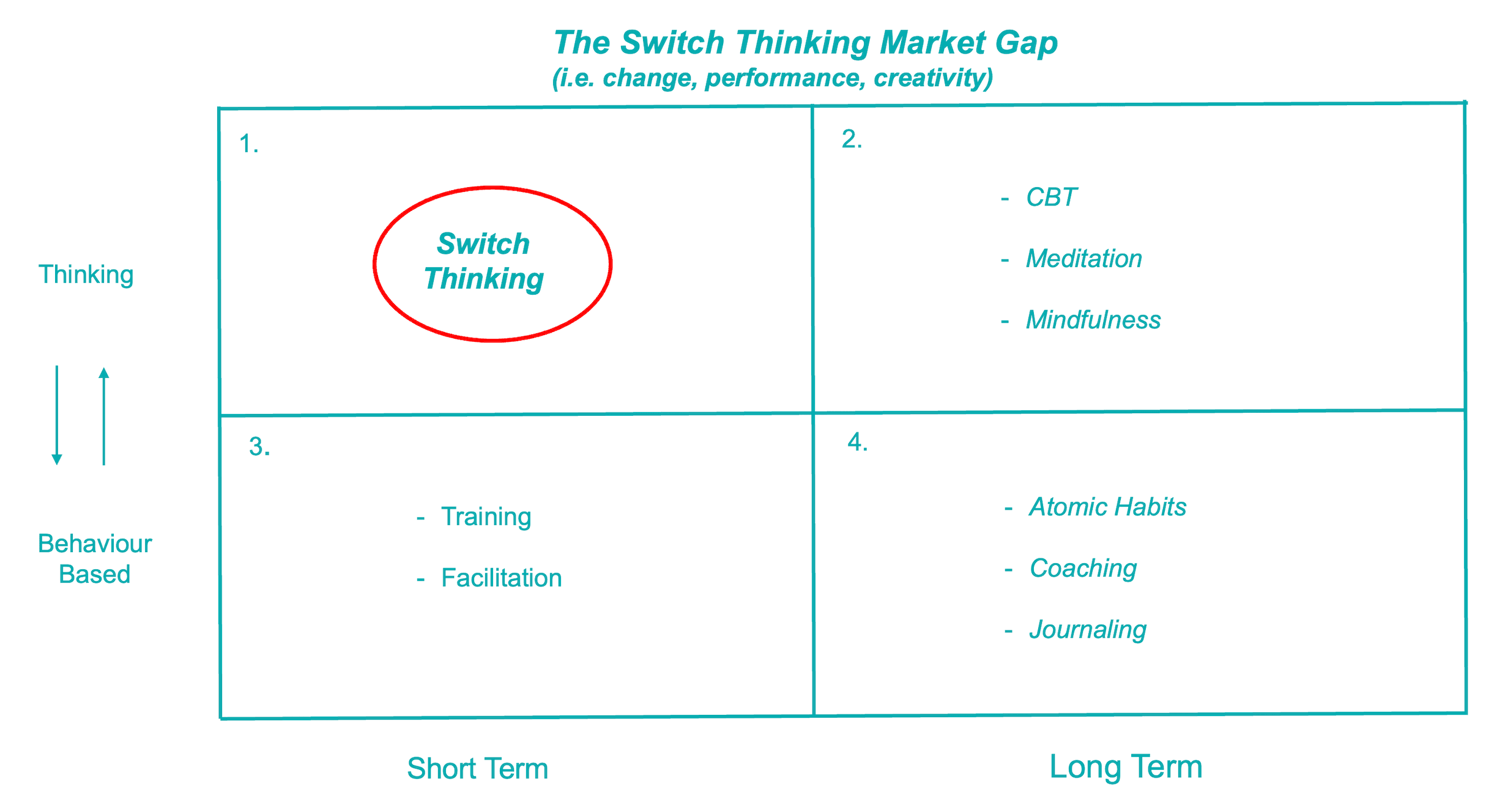
A simple 2 by 2 matrix might help answer these questions.
On the vertical axis are approaches that primarily focus on thinking or behaviour.
The two are interdependent but lets play with the idea of what is the dominant idea.
Switch Thinking for example as the name implies is concerned with thinking.
On the horizontal axis is mostly concerned with a short term or long term result.
So we have 4 quadrants:
Number 1. Thinking and Short Term
This is where Switch Thinking sits.
And as you can see (in my opinion) Switch Thinking sits alone compared to other approaches to change, creativity and performance.
Switch Thinking gives you a simple way to change in the moment.
Often a 2 minute switch in thinking can make a big difference – right now.
This can not only help you now but build confidence and capability in the longer term.
For example,
If you are working with a group you can ask:
What are the latest results?
Switch
Then you can ask, how is everyone feeling?
An equally important and valuable question that can help you and others tp perform at a higher level.
2. Thinking + Long-Term
These include approaches like CBT, meditation, and mindfulness.
They help you:
- build awareness
- reframe thoughts
- develop emotional control
They are powerful.
But and it’s a big but.
They take time to learn and embed.
They are not always designed for instant application in a live moment.
3. Behaviour + Short-Term
This is where training and facilitation sit.
They help you:
- take action
- learn new skills
- engage in the moment
But often the impact fades once the session ends.
The learning doesn’t always transfer into real life when it matters.
4. Behaviour + Long-Term
This includes ideas like habit formation and coaching.
They help you:
- build routines
- create consistency
- improve over time
Again, highly effective.
But gradual.
They focus on change over weeks, months, even years.
The Market Gap
If you map these approaches, something interesting appears.
There is a gap.
A space that is:
- immediate
- practical
- repeatable
- usable in real time
A space that sits between thinking and action.
A space focused on:
What can I do in the next 2 minutes?
Enter Switch Thinking
Switch Thinking is designed specifically for this gap.
It is not about long-term transformation (although that may follow).
It is about short, deliberate shifts in the moment.
It revolves around 6 Switches:
- Switch your perspective
- Switch your focus
- Switch your emotion
- Switch your question
- Switch your assumptions
- Switch on your imagination
Each one is a small move.
But small moves can create powerful outcomes.
Why this matters
In a world of constant change, most of our challenges are not long-term.
They are immediate.
- A difficult conversation
- A moment of self-doubt
- A decision under pressure
- A creative block
- An unexpected problem
These are what I call “moments that matter.”
And they happen every day.
From reaction to choice
Without a switch, we tend to react automatically.
We fall back on:
- habits
- emotions
- default thinking patterns
But with a switch, something different happens.
You create a pause.
And in that pause, you gain a choice.
Do I continue this pattern?
Or do I switch?
That one decision can change:
- how you think
- how you feel
- what you do next
Small switch, big impact.
One of the most powerful ideas behind Switch Thinking is this:
You don’t need a big change to create a meaningful difference.
Sometimes all it takes is:
- switching from fear to curiosity
- switching from problem to possibility
- switching from talking to listening
- switching from adding more to removing what’s not needed
These shifts can happen in seconds.
But their impact can last far longer.
A bridge between worlds
Switch Thinking sits between two worlds:
- thinking and action
- logic and imagination
- structure and creativity
It acts as a bridge you can cross over to the other side, even for a few moments.
A way to move between modes, rather than being stuck in one.
Why now?
We are living in a time where:
- attention spans are shorter
- change is faster
- expectations are higher
We don’t always have the luxury of time to reflect deeply or build new habits slowly.
We need tools that work in real time.
The opportunity:
The opportunity is not to replace existing approaches.
It is to complement them.
Think of Switch Thinking as:
The missing link between insight and action
Or more simply:
A way to change in the moment
A final thought
Most approaches help you become better over time.
Switch Thinking helps you become better right now.