
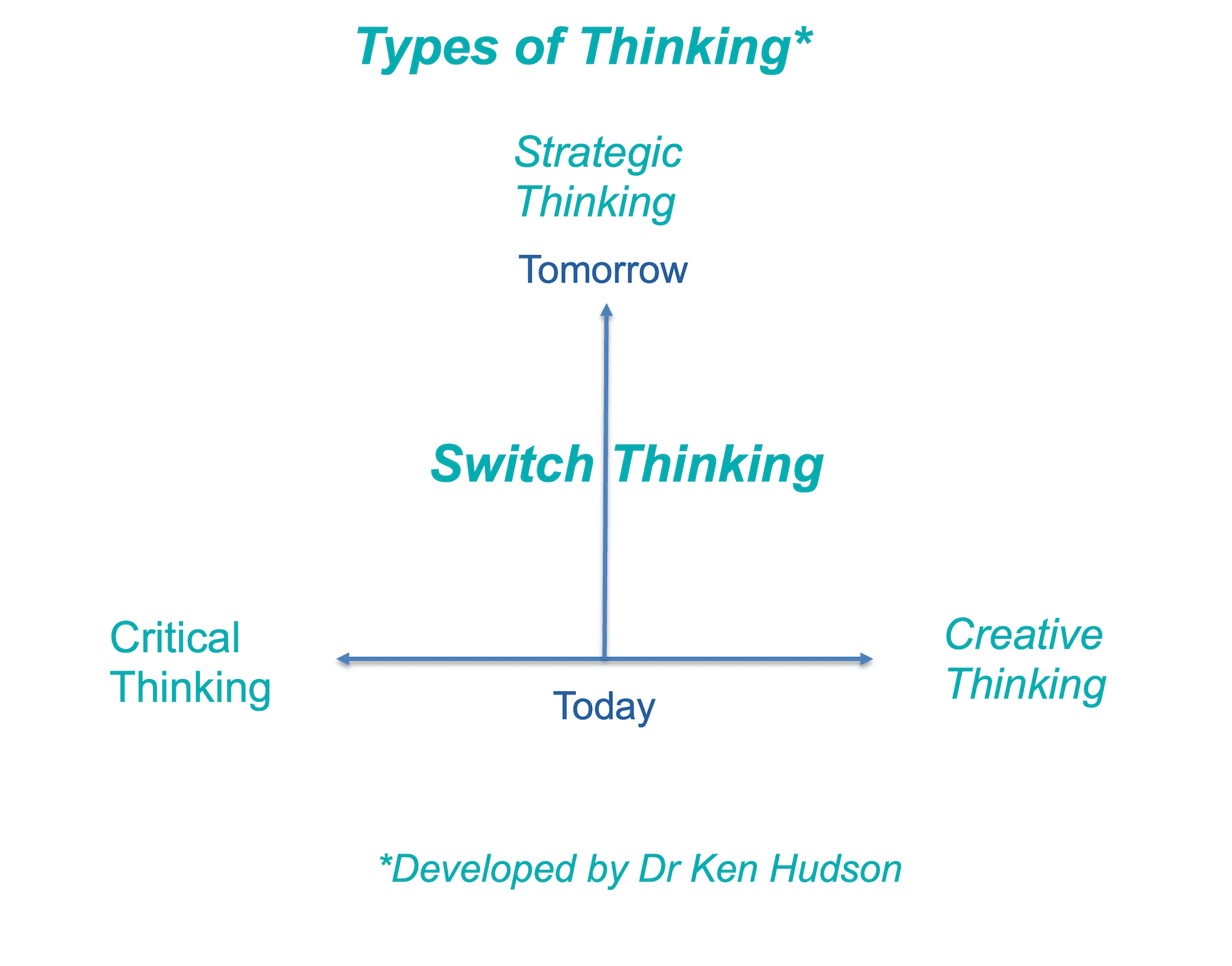
In our education system most of us have been taught critical thinking.
But of course there are other ways of thinking.
Design thinking, systems thinking, lateral thinking, strategic thinking and visual thinking to name a few.
Each approach has value.
But there is a gap.
The challenge is that life rarely requires just one type of thinking.
In reality, we often need to move between different ways of thinking depending on the situation.
The ability to make that shift may be one of the most important skills in a rapidly changing world.
This is where Switch Thinking comes in.
Here is the problem with staying in one mode
Imagine you are facing a difficult challenge.
If you rely only on critical thinking, you may become overly focused on risks, problems and limitations.
If you rely only on creative thinking, you may generate lots of possibilities but struggle to make decisions or take action.
If you focus only on strategic thinking, you may spend so much time thinking about the future that you overlook what needs attention today.
The issue is not that any of these approaches are wrong.
The issue is knowing when to use each one.
Many people become stuck because they continue using the same thinking style even when the situation requires something different.
The Switch Thinking Approach
The magic (i believe) is in switching between the different ways of thinking and use the most appropriate way of thinking depending on the situation.
In Brainstorming you can start in creative thinking then switch to critical thinking.
Perhaps in planning the future you might start using strategic thinking then switch to analysis for example.
And then to try and connect the different types of thinking to develop something new and fifferent.
Think of Parasailing as an example.
Hence, Switch Thinking is the ability to move deliberately between different ways of thinking as circumstances change.
Why this matters
The modern world rewards adaptability.
We face constant change and uncertainty.
It feels chaotic at times.
This can often feel overwhelming, we can get stuck or unsure of what to do next.
In these moments, the solution is not always more thinking.
It may be different thinking.
For example:
If you are feeling overwhelmed, you may need to switch from future thinking to present thinking and ask:
“What matters most today?”
If you are feeling stuck, you may need to switch from critical thinking to creative thinking and ask:
“What if?”
If you have lots of ideas but little progress, you may need to switch from creative thinking to critical thinking and ask:
“Which idea should I act on first?”
The ability to switch allows you to match your thinking to the moment.
A Skill for a Changing World
The great news is that Switch Thinking is a skill.
The ability to switch.
This means that it can be learned and developed through practice.
And it comes with a new language e.g. switching and tool kit e.g. Two modes which I call Box Mode and Ball Mode and 6 switches.
Switch Thinking does not replace other forms of thinking.
It connects them.
And that may be why it is becoming one of the most valuable thinking skills for the future.
The most important thinking skill is not creative thinking, critical thinking or strategic thinking.
It is knowing when to switch between them.