
We have all felt it.
It’s a big presentation, meeting or interview.
We have prepared, rehearsed and yet when the moment arrives, when we have to perform we get stuck.
Our mind goes blank or we keep going over the same points.
The unexpected question or comment has thrown us.
What to do?
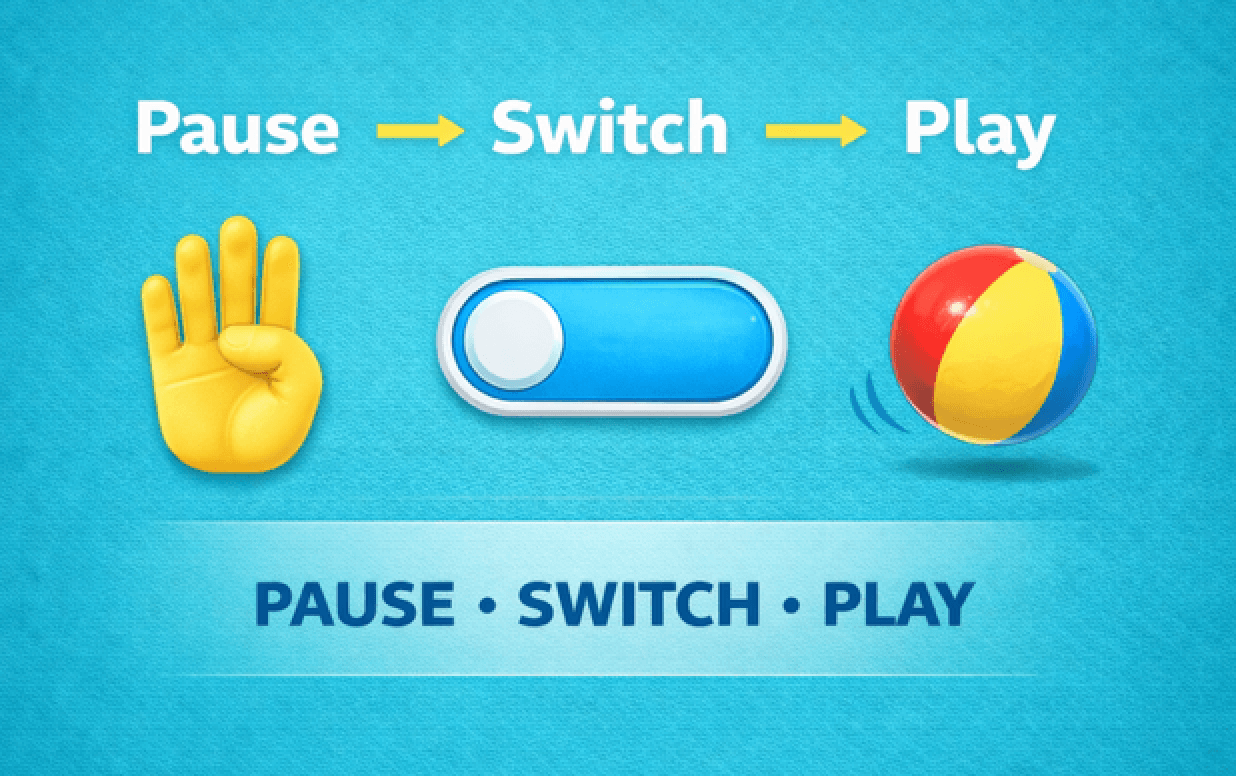
Here is a simple, easy 3 step process to help you in these situations so you never get stuck again.
I call it.
Pause. Switch. Play.
It can help you be at your best in moments that matter.
- Pause
Getting unstuck begins with a pause.
We live in a world of speed.
Messages ping.
Meetings stack.
Deadlines compress.
Emotions flare.
And in these moments — especially the important ones — we tend to react automatically.
We default to our usual thinking pattern.
For most people this is what I call Box Mode: logical, efficient, controlled, serious.
Box Mode is incredibly useful.
It helps us plan, analyse and execute.
But under pressure, Box Mode can harden, we can become rigid and Defensive.
We close down instead of opening up.
That’s where a small, deliberate interruption can change everything.
The pause is the most underestimated move in modern life.
It might be one breath.
It might be one silent second before replying.
It might be a conscious decision not to speak immediately.
It might just taking a moment to really listen or observe or feel.
What is happening? What is not working?
But that tiny pause creates space.
Neuroscience tells us that without a pause, we operate on autopilot.
With a pause, we create a gap between stimulus and response, in this gap lies choice.
The pause is not weakness.
It’s power.
When a colleague challenges you.
When your child says something unexpected.
When a client asks a difficult question.
When anxiety rises before a presentation.
Pause.
You are not freezing.
2. Switch
After the pause comes the deliberate shift.
Switching simply means: Change the way you are looking at the situation.
It’s a deliberate, proactive decision to switch how you think.
In the Switch Thinking System there are 6 Switches.
These are:
- Perspective (How would a beginner see this?)
- Focus (What’s working here?)
- Emotion (What would confidence feel like right now?)
- Question (What’s a naive question to ask?)
- Assumption (What if the opposite were true?)
- Imagination (What would make this fun?)
It doesn’t matter which switch you use.
The key is not perfection.
The key is movement.
Imagine you are driving on a highway and need to take an exit.
You slow down (pause), then you turn the wheel (switch), the road instantly changes.
The situation hasn’t changed.
Your direction has.
Or imagine swiping right in your mind — from rigid to open, from serious to curious.
You can even make it physical.
For example, move your hand slightly to the right, roll a small ball in your palm, turn a pen in your fingers.
The physical cue reinforces the mental shift.
Switching is not about abandoning logic.
It’s about temporarily stepping out of your default pattern.
Often, that’s enough.
3. Play
This is the part most adults forget.
Play does not mean being silly.
It means being open.
It means loosening the grip.
It means exploring without immediately judging.
When you switch into what I call Ball Mode, you allow yourself to:
- Try an idea quickly.
- Ask a different question.
- Use a metaphor.
- Smile at the absurd.
- Imagine a wild alternative.
Play removes the fear of being wrong.
In high-pressure moments, we often become overly serious, ironically, this shrinks our thinking – play expands it.
When you play, your thinking becomes more flexible, more creative and energetic.
And you only need to do it for 2 minutes.
And here’s the secret:
You can always switch back.
That’s why play feels safe.
You’re not committing forever.
You’re experimenting for 2 minutes.
Why Pause – Switch – Play helps you get unstuck
Pause interrupts the autopilot.
Switch redirects your mental energy.
Play unlocks possibility.
Together, they create a fast, repeatable pattern for performing at your best in moments that matter.
You don’t need a workshop.
You don’t need a 10-step framework.
You need three words.
Pause. Switch. Play.
A Real-Life Example
Imagine you walk into your home after a long day.
You’re tired, irritated perhaps mentally overloaded.
Your child runs toward you, excited.
Your default might be Box Mode: “Not now.”
Instead:
Pause.
Switch perspective: What does this moment look like through their eyes?
Play: Smile. Drop your bag. Give a dramatic “Tell me everything!”
The moment transforms.
Same situation.
Different outcome.
The Compound Effect
One pause won’t change your life.
But a thousand small pauses might.
One switch won’t transform your leadership.
But repeated switching builds agility.
One playful question won’t redefine a culture.
But normalising play might.
This is how small switches create big impact.
In the next conversation that feels tense, rushed or stuck:
How to get unstuck in summary:
- Pause.
- Switch anything.
- Play with it for two minutes.
Then see what happens.
You might discover that sometimes only one move — one small mental move — is all it takes.
And that move begins with three simple words:
Pause. Switch. Play.