
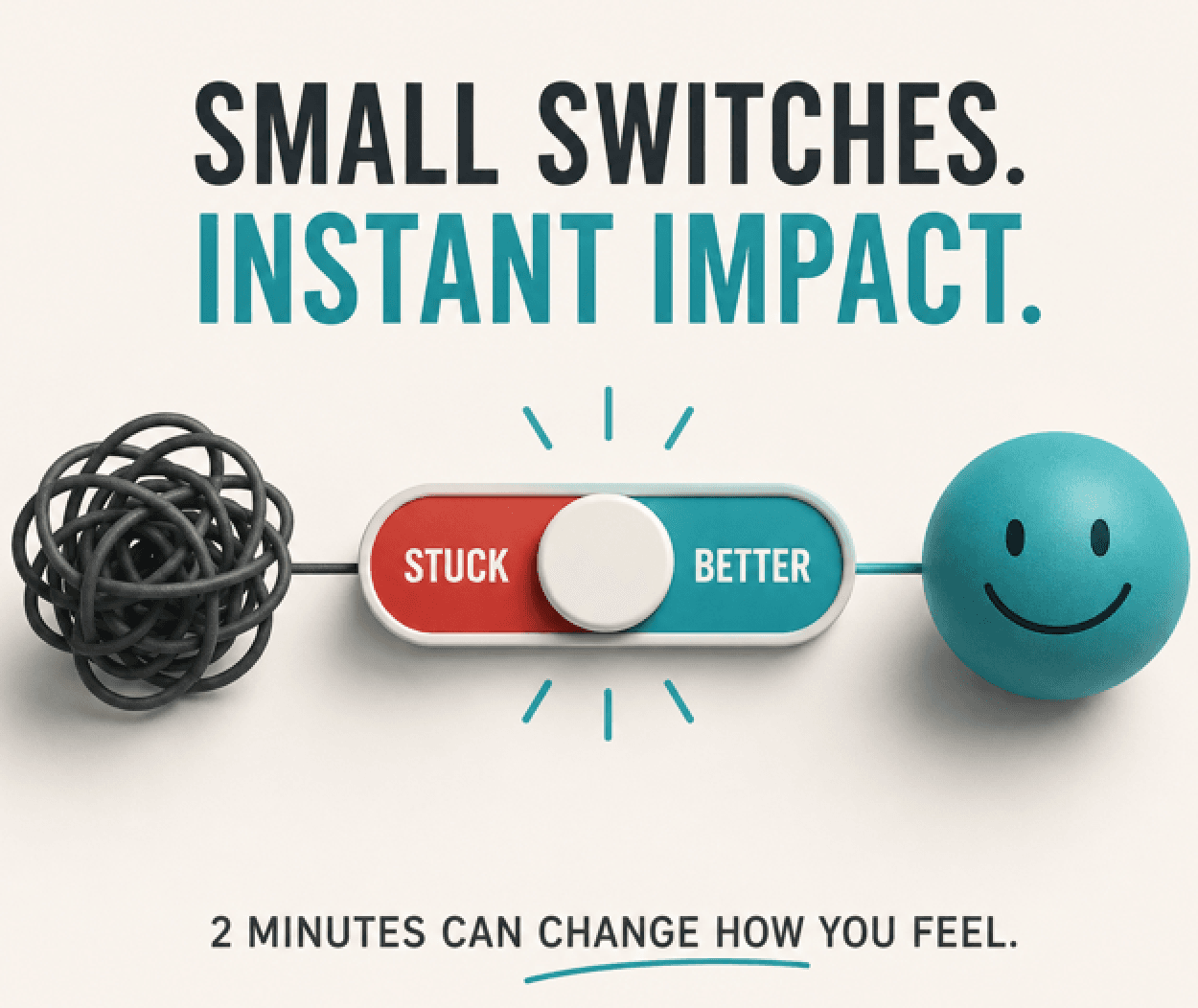
What if a small switch in your thinking for just two minutes could instantly change how you feel?
Most of us assume we need to change our circumstances before we can change how we feel.
But what if we’ve got it the wrong way around?
Over the past few months, I’ve noticed something interesting in my own life.
By making a small switch in my thinking, I can often change how I feel almost instantly—even when nothing around me has changed.
That’s the idea behind Switch Thinking.
It’s not about pretending everything is wonderful or ignoring reality.
It’s about deliberately choosing a different way of thinking that helps you respond more effectively in the moment.
Here are seven examples from my own life.
1. The dentist’s chair
I was lying in the dentist’s chair feeling slightly uncomfortable.
Instead of focusing on the treatment,
I imagined myself standing on stage giving a presentation with a big white smile.
Within moments my attention had shifted.
Before I knew it, the dentist said, “We’re finished.”
The dentist hadn’t changed.
My thinking had.
2. Walking through a crowd
I was walking through a crowded group of people and started to feel a little nervous.
So i then switched and imagined I was walking peacefully through a field of flowers instead.
Almost immediately I felt calmer and more relaxed.
The crowd was still there.
My experience wasn’t.
3. Waiting in a long queue
We’ve all stood in a long queue, watching the minutes tick by.
My first reaction is nearly always frustration.
Then I switched my thinking.
Instead of seeing it as wasted time, I thought, “This is my quiet time.”
For a few minutes I simply enjoyed having nothing to do.
The queue didn’t become shorter.
But it became more enjoyable.
4. A difficult conversation
During a discussion with a friend, he became increasingly negative—almost aggressive.
My instinct could easily have been to become defensive.
Instead I asked myself:
“I wonder why he sees it that way?”
Curiosity replaced defensiveness.
The conversation stayed constructive.
5. Walking home
After finishing my shopping one day, I felt tired and was about to call an Uber.
Then I imagined how proud I’d feel if I walked home instead.
Instantly I felt a spring in my step.
I walked home feeling energised and surprisingly proud of myself.
It was a small switch in my thinking that changed how I felt and what I did.
6. Feeling flat
Yesterday I was feeling a bit down.
My first instinct was to analyse why.
Instead, I asked a different question:
“What’s one meaningful thing I could do right now?”
I decided to visit a local bookshop and talk to the owner about my new book.
Within minutes my mood lifted.
The feeling reminded me of how I feel after a good workout at the gym.
7. Stuck in traffic
Driving in traffic, the driver of a ute suddenly pulled in front of me.
My first reaction was annoyance.
Then I thought:
“They’re probably trying to earn a living and may be in a hurry. I’m not.”
I even imagined that, in my own small way, I was helping them.
My frustration disappeared.
Nothing about the traffic had changed.
Only my thinking had.
A pattern emerged
Looking back at these examples, I realised something important.
The situations were all different.
A dentist.
A crowd.
A queue.
Traffic.
A difficult conversation.
Feeling flat.
Walking home.
But they all had one thing in common.
A small switch in thinking created an immediate impact.
That’s why I’m increasingly describing Switch Thinking like this:
Small switches. Instant impact.
A life skill, not a trick
There’s another interesting observation.
These switches came to me naturally.
I didn’t stop and think, “Which chapter of my book should I apply?”
The switch simply happened.
That took me back to the original inspiration behind Switch Thinking.
As a bilingual person, switching between languages eventually became automatic.
I didn’t consciously decide which language to use every time I spoke.
The same thing seems to be happening with Switch Thinking.
At first, switching is deliberate.
With practice, it becomes quicker.
Eventually, it becomes part of how you think.
That’s why I don’t see Switch Thinking as another self-help technique.
I see it increasingly as a vital life skill.
A skill that helps you navigate the hundreds of small moments that make up every day.
Most of us don’t need a new life.
We need a better next moment.
And sometimes, that’s only one small switch away.