
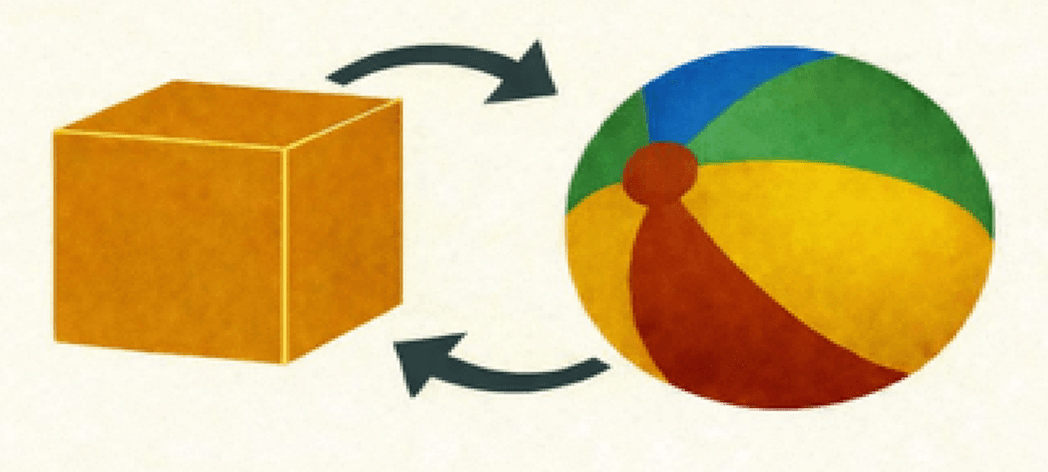
In the Switch Thinking System there are two thinking modes.
Note these are modes not people.
Everyone can learn to use both modes and move between them.
These two modes are called Box Mode and Ball Mode.
There are two different modes of operating that complement rather than compete with one another.
You can of course, use either Mode with AI or a group or team.
But first,
What is Box Mode?
As the name suggest I am using Box Mode as a metaphor for a more structured way of thinking.
Its the mode that most people (at work) use every day.
It is rational, logical and concerned with solving problems efficiently.
Its a rough approximation of your brain’s Central Executive Network.
When we operate in Box Mode we are asking questions such as:
- What is the problem?
- What are the facts?
- What works and what doesn’t?
- What are the risks?
Box Mode is extremely valuable. It helps us:
- analyse information
- make decisions
- plan actions
- evaluate ideas
In many ways, Box Mode is about making thinking more precise.
It narrows our focus so we can move forward in a clear and organised way.
But Box Mode has a limitation.
When we stay in it for too long, our thinking can become predictable.
This can mean our competitors can leap ahead of us and at the very least our customers can become bored.
We tend to repeat familiar patterns and rely on past experience.
This can mean that we can get stuck particularly in pressure situations.
That’s where the second mode comes in.
Ball Mode
As the name suggests think of a ball.
Its fun, colourful and playful.
Its the perfect metaphor i have found to discuss a different way of thinking.
Not good or bad, just different.
Instead of narrowing possibilities, Ball Mode expands them.
It’s an approximation of our Default Mode Network (i.e. mind wandering).
In Ball Mode we might ask:
- What if we tried something completely different?
- What would this look like from another perspective?
- What’s the most unusual idea we could try?
- What assumptions might we challenge?
Ball Mode encourages imagination, curiosity and exploration.
It is often where we generate:
- creative ideas
- unexpected insights
- new possibilities
Many creativity techniques—such as brainstorming—try to put people directly into Ball Mode by encouraging free thinking and suspending judgement.
But this approach can miss something important.
Here is a kicker, higher creative performance does not come from Ball Mode alone.
The Power of Switching
Recent neuroscience research suggests that creative thinking may depend on switching between different brain networks, rather than staying in just one mode.
As i have mentioned there are two important brain networks:
- the Central Executive Network, associated with focused, analytical thinking
- the Default Mode Network, associated with imagination, memory and idea generation
Studies suggest that highly creative thinkers tend to move flexibly between these networks, rather than remaining locked into one.
In other words, creativity may come from the dynamic switching between structured thinking and imaginative thinking.
This idea is captured perfectly by the relationship between Box Mode and Ball Mode.
Box Mode helps us evaluate and refine ideas.
Ball Mode helps us generate new possibilities.
When we switch between the two, something powerful happens.
Ideas are not only created—they are also shaped and improved.
What This Means for Brainstorming
Traditional brainstorming often encourages people to stay in creative mode.
Participants are told:
- generate as many ideas as possible
- avoid criticism
- think freely
While this can help people produce ideas, it can also lead to sessions where many ideas are generated but few are developed into useful solutions.
The Box Mode / Ball Mode switching model suggests a better approach.
Instead of remaining in one mode, brainstorming sessions could deliberately alternate between the two.
For example:
- Ball Mode: Generate unusual ideas and possibilities.
- Box Mode: Evaluate which ideas have potential.
- Ball Mode: Build on the strongest ideas and explore variations.
- Box Mode: Refine and prioritise the best solutions.
This rhythm creates a more dynamic thinking process.
Ideas are not only produced—they evolve.
The Two-Minute Switch
The beauty of this approach is that the switch between modes does not need to be complicated.
Sometimes a simple Ball Mode prompt can trigger the change:
- “What is another perspective?”
- “What assumption are we making?”
- “What is the most ambitious version of this idea?”
Even a brief shift in thinking—sometimes just a minute or two—can open up new possibilities.
That’s why the concept of the 2-minute switch is so powerful.
Small shifts in thinking can create surprisingly large changes in insight.
A Simple Habit for more Creative Thinking
Box Mode and Ball Mode are not rivals.
They are partners (think Lennon and McCartney).
One provides structure.
The other provides imagination.
When we learn to switch between them, we unlock a more flexible and powerful way of solving problems, getting unstuck or releasing the energy in the group..
Instead of getting stuck in one mode, we develop the ability to move between analysis and creativity, focus and exploration, structure and play.
And sometimes all it takes is a small switch.