
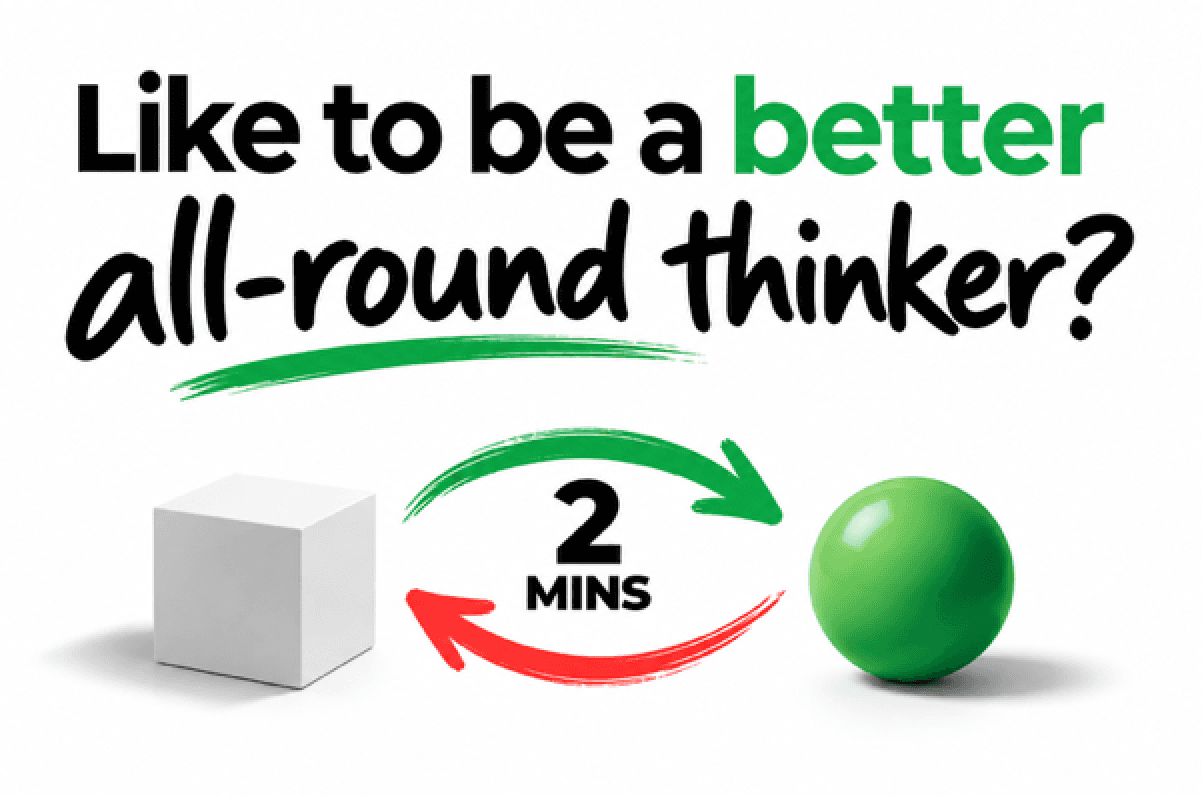
Would you like to be a better all-round thinker?
I would.
But what does ‘better’ mean?
By better I don’t mean more intelligent.
I mean more efficient, agile, creative and empathetic.
It means thinking with a bigger impact in a shorter time – often in minutes!
And I believe this can be developed by learning to switch and connect different ways of thinking – on demand.
I call this skill Switch Thinking.
Let me go through these claims one by one.
Think more Efficiently:
Switch Thinking is done in two-minute bursts.
You need only switch your thinking for two minutes or less to develop another idea, possibility, solution or option
In a time-poor, low attention world this is a big plus.
This means that you do not have to wait for a brainstorming session in say three weeks’ time when everyone is available.
You do not have to wait for the right people to be available or the right place to be free.
You can start working on a problem, issue or gap – right now.
The other big benefit is that if the switch does not work you have lost just two minutes.
Think in a more Agile way
Professor Adam Grant suggests agility not just ability is the new passport to success.
If this is the case then switch thinking provides a practical way to practice this kind of mental agility.
It moves from an aspiration (i.e. be more agile) to an ability, process and tool kit.
It also means you can access this switch in thinking when you most need it.
It could be in a presentation when you are asked an unexpected question, or in an interview or perhaps when your client or team are stuck.
You need to be able to use a tool under pressure in real time not just when you have loads of time away from the action of the front line.
For example;
You might be a leader giving some well-intentioned feedback to a colleague or team member and the conversation suddenly goes south.
You need to switch – right now.
What is my perspective?
Switch
What is their perspective?
In this small switch you may gain a better insight on why they are reacting in a certain way and with this insight you can change your feedback approach.
Think more Creatively.
Switching to what I call Ball Mode (more on this later) also has another big advantage.
It can help open up more imaginative thinking – right now!
Consider this example:
How can I solve this problem?
Switch
How can I play with this problem?
It’s a simple switch of a word from solve to play.
The former dictates a certain mode of thinking which I call Box Mode.
This will naturally lead you to using a more structured thinking approach involving analysis, logic, data, trends and linear processing.
Now consider the word play.
For me, this suggests an exploration of different possibilities, fun and imagination.
This non-linear, unstructured approach I call Ball Mode.
Both are valid, both are valuable.
Together they create the potential of developing a better idea, solution or experience.
Think with more Empathy
Switch Thinking as the name implies encourages you to see a problem or situation from multiple perspectives.
This can help you better understand others and can boost your empathy and collaboration.
It gives you a new language to talk about change, creativity, learning and growth in any team or client situation.
For example:
What is a win for me?
Switch
What is a win for them?
This switch doesn’t magically create empathy.
But temporarily seeing a thinking about a win for the other person may lead to more creative solution that appeals to both of you.
Here is another example:
This is what I am good at.
Switch
This is what (I believe) you are great at.
Why don’t we connect and learn from one another?
This type of switch can move the conversation away from ‘me verses you’ towards what might work for both of us.
Think with greater Impact
These benefits suggest that Switch Thinking can help you become a better all-round thinker.
But what about impact?
Can a switch in thinking lead to a positive impact.
From my experience the answer is a resounding yes.
Often a bite-size switch can make a big difference in how you see, feel and act.
Consider this real case study.
I was working with a group of consultants, and their challenge was how to attract the best and brightest graduates to their organisation.
They worked on this challenge for a while, and they became frustrated with their usual ideas.
I suggested a switch in the challenge using emotional language (e.g. frustration, anger, joy etc).
And then one brave consultant suggested a new challenge,
Why don’t we try and become the most loved brand in Australia?
There was a hush in the room followed by an outburst of energy.
If we become the most loved brand in Australia, graduates would flock to work for us they realised.
This led to a rapid outpouring of creative energy.
Who do we now compete with someone asked? Not other consulting companies but Apple, LEGO for example.
How do we measure love someone else asked?
A great question.
The important point was that a small switch in the challenge opened their minds to a range of new ideas, insights about the competition, perhaps some new metrics and an entirely new strategy.
Small switch – big impact.
What do I mean by all-round thinker?
Under pressure we often default to a thinking pattern that has worked in the past.
This makes perfect sense because it is efficient and saves us time and effort.
This for most people in organisations is critical thinking.
Again, this is an appropriate response given a requirement to deliver results, meet targets and allocate resources.
However, it means that you are only thinking in one way.
But you can also think in other ways – creative thinking, imagination, systems thinking or visual thinking to name a few.
To simplify things with Switch Thinking there are two modes (1).
Box Mode (i.e. structured, focused, logical, analytical, critical).
Ball Mode (i.e. unstructured, playful, open, exploratory and imaginative).
The goal is not just to escape Box Mode and become more creative.
Nor is it to abandon imagination and become more analytical.
The skill is being able to switch and connect the two when you need it.
It’s worth noting that you do not have to be stuck to switch.
Sometimes I switch because my current approach is not working.
But increasingly I like to switch for the sheer sense of joy and exploration that emerges when you switch your thinking.
And what I have found is that the more I switch, the more I trust my switching process.
You often land in the most unexpected of places and that is part of the fun.
And notice these are modes not types of people. Anyone can use either mode, at any time, for any purpose.
Switching and connecting Box Mode and Ball Mode means you are not locked into either critical or creative.
You can use both depending on the moment.
For example:
Box Mode: What are the facts in this situation?
Switch
Ball Mode: How are people feeling?
In one tiny switch of thinking you are now focused on feelings rather than just facts.
This gives you a more complete view of the situation.
Let’s consider the game of cricket as a useful analogy to explain the idea of an expanded range of thinking modes.
Cricket has been going through a revolution as the game has been moving from five-day test matches to a more limited over approaches.
This form of cricket has meant that every player needs to become adept at least two of batting, bowling and fielding.
Perhaps then, we all need to become all-round Box and Ball Mode thinkers?
Becoming more of an all-round thinker applies to the growing number of people that are starting their own business, operating as a freelance professional or running a gig on the side.
Or you might be working from home, in a café or anywhere in between and don’t have ready access to a group or team.
In these circumstances you need to think by yourself, for yourself.
You need to be able to create a new idea, enhance, evaluate, prioritise, plan and test it.
You need to adopt a Swiss army knife approach to thinking.
The key – Switch Thinking
As I have been alluding to, the secret to becoming a better all-round thinker is developing the skill of switching your thinking depending on the moment or situation – on demand.
And for just 2 minutes.
For example:
What is the current client experience?
Switch
What might be the ideal client experience.
Suddenly this switch feels more exciting and liberating.
You start drawing the ideal experience.
Ideas start flowing and your energy levels go sky high; you are playing in Ball Mode.
For the next two minute you go for it without worrying about budget, timing, benchmarks etc.
You find that you have outlined a transformative client experience in just 2 minutes.
Now you switch back to Box Mode and start to plan how can you move from your current client experience to the ideal one.
Becoming a better all-round thinker becomes more than an aspiration.
You have created something special, by yourself – in minutes.
And if you can do this once.
Why not experience this again?
And again?
You gain more confidence and what I have found is that you start to see switch thinking opportunities everywhere.
You now know there is always another way to see a situation.
I call this the Switch Thinking organising principle.
What is Switch Thinking?
Switch Thinking is the deliberate and proactive ability to change your thinking from one mode to another.
There is no right or wrong way to switch.
The emphasis is on movement from one mode to another and back again.
Switch Thinking builds on what you are already doing.
You can switch a conversation, switch your concentration, switch gears in a bike or switch how you respond to your clients, partner and kids (if you have them).
I have developed what you are intuitively doing and given it structure and applied it to your thinking.
Here is another switch example.
The magic is in the creative tension.
The many small and big interactions between:
Box Mode: Why?
Switch
Ball Mode: Why not?
Suddenly what you have been putting off or developing the numerous reasons why you should not do something fade away.
You give yourself permission to explore and consider a new possibility.
Switch Thinking can also be used with AI with great effect.
There is a debate whether AI is starting to replace human thinking.
In some cases, such as analysis of data for example, AI is quicker than any human in terms of processing, evaluating and summarizing vast amounts of data.
This has led to an ‘either or’ discussion of human vs AI Thinking (or more accurately processing).
But this misses the point.
The goal is not human or AI thinking.
But human and AI thinking.
Or even better, Human x AI thinking.
For example, after every prolonged interaction with ChatGPT I ask it to develop an image that represents or communicates the main themes of the conversation.
This often summarizes the conversation and sometimes proves me with new stimulus which enhances my thinking even more.
The key point is that you are in control of your thinking with AI.
This amazing tool enhances your ability to think it does not replace it.
However, many of us are becoming increasingly dependent on AI.
If you continue to outsource your thinking to AI my fear is that your thinking muscle becomes weaker.
And if this happens at the very least, how can you tell if what AI is producing makes sense?
If AI is becoming better at answering questions, then humans need to become better at asking questions.
My point is this.
Our human thinking can be enhanced by AI but should not be driven by it.
So, would you like to become a better all-round thinker?
It’s not about intelligence.
It’s about noticing how you think and realising that you can switch.
You can switch your perspective, focus, assumptions you make or the questions you ask.
It’s up to you.
You have control over your own thinking.
You have agency.
If your switch does not work out, you can go back to your usual way of thinking.
But I rarely do.
I have become more confident in my own thinking ability and in sharing my message with others.
And it’s free, you can start in the next two minutes, and you don’t need anyone’s permission.
The other aspect of Switch Thinking I love is that it is not dependent on how much money you have, what school you went to, what you do or who you mix with.
With Switch Thinking, you can become a better all-round thinker.
(1) These modes are metaphors that roughly approximate to the Brain Networks (i.e. Central Executive Network, The Default Mode Network and The Salience Network)