
I have long been a fan of Agile Methodology for project management and software development.
The idea of small rapid releases, rapid iteration, client feedback and lots of collaboration is such a smart idea in a rapidly changing environment.
When requirements change this methodology ensures that you can change.
Now what if there is a bigger idea?
Not just agile for software development but agile for thinking.
In short, An Agile Mind.
When I think of an agile mind I think of words such as flexibility, openness, curiosity and adaptability.
These are all important no doubt.
But these feel to me like traits.
And as such you either have these or you don’t so the experts suggest.
But what if, developing an Agile mind is more of a skill that a trait?
If so, then it can be developed and improved like any skill.
Is this a new way to think about an Agile Mind and agility more broadly?
An Agile Mind might be defined like this:
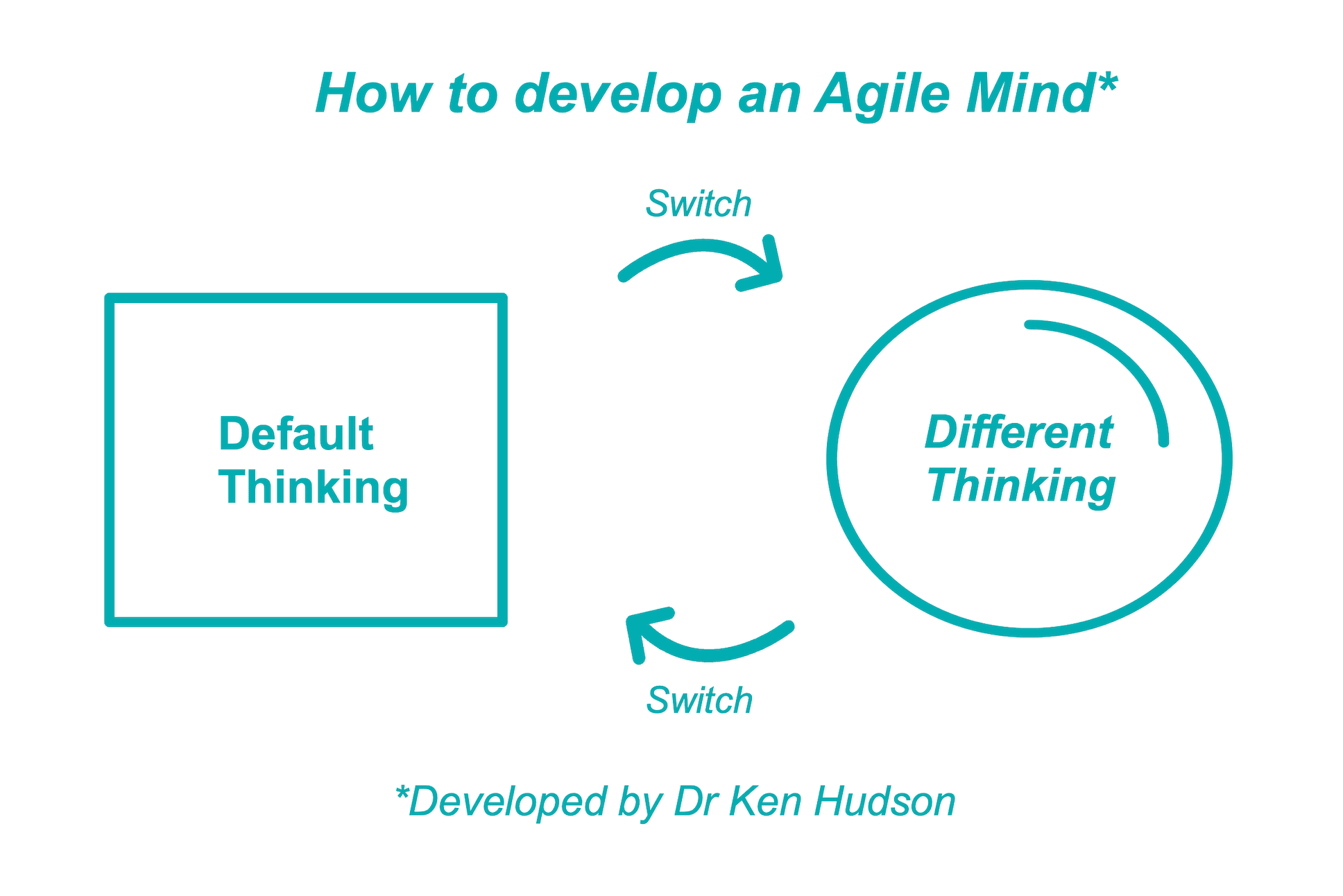
‘Your ability to switch from your default way of thinking to a different one – in a moment.’
Let’s play with this.
Your default way of thinking is how you see, feel and act in most situations.
It’s automatic.
It’s worked in the past and this way of thinking is safe and comfortable.
But when this is no longer the case or there is a sudden change in say the budget, timing or people for example you might need to change.
You might need to switch to a different way of thinking.
This switch from your default way of thinking to a different way is a sign of an Agile Mind.
The good news is that you can always switch back.
This switching back and forth is a skill that can be developed through what I call Switch Thinking.
For example,
Your default way of thinking might be focused on problem solving.
You see a problem and you know what to do.
You scan the environment, look for root causes and off you go.
This is a powerful and effective way of thinking.
But it is not the only way.
Let’s switch.
What if there is not a problem handy?
What do you do?
Also consider this.
Where is the opportunity to try something new, learn and grow rather than your usual approach which is to focus on problems.
You have switched your thinking from problem solving to opportunity creating.
In Switch Thinking language you have switched from you default to a different way of thinking.
And have done this is a moment not a month or in 12 months time.
You have switched when you need to and when it matters the most.
Not better or worse.
Just different.
You have switched your thinking.
This might mean:
- changing your perspective
- trying a new approach
- reframing the situation
- exploring a new possibility
And crucially, you can do this in the moment—not later, not after reflection, but while the situation is still unfolding.
And every time you switch (either way from default to different or back again) you develop a more Agile Mind.
And because you always have your mind you do not have to wait for a group or team, the right moment, mood or location.
You can switch.
Whenever and wherever you are.
You can switch in real time, much like you have learned to talk then switch to listening (well most of us).
Why an Agile Mind Matters More Than Ever
We are operating in a world that is fast, unpredictable and complex.
Plans become outdated quickly.
Conversations shift unexpectedly.
Competitors don’t always follow the rules.
In this environment, success is less about having the perfect plan—and more about how you respond when things change.
Consider these everyday situations:
- You’re asked an unexpected question in a meeting
- A conversation becomes tense
- A client wants a quick answer
- Your team is stuck
- Your initial idea isn’t working
You can’t pause the moment and come back later with a better answer.
You need to respond now.
An agile mind gives you that ability.
It empowers you to adjust your thinking quickly, perhaps move in a new direction, better understand another perspective or discover a new insight.
Small Switches, Big Impact
The good news is that developing an agile mind doesn’t require massive change.
It starts with small switches.
For example:
What is my perspective?
Switch
What is yours?
This small change in thinking can unlock entirely different responses.
And often, that’s all you need.
A Practical Way Forward
The next time you feel stuck, under pressure, or unsure, try this:
Ask yourself or others:
“What’s a different way I could think about this—right now?”
You don’t need the perfect answer.
You just need a different one.
Final Thought
An agile mind isn’t about having all the answers.
It’s about having the ability to change how you think—when it matters most.
Or more simply:
An agile mind can switch its thinking—in the moment.
And in a rapidly changing world, that may be one of the most valuable skills you can develop.