
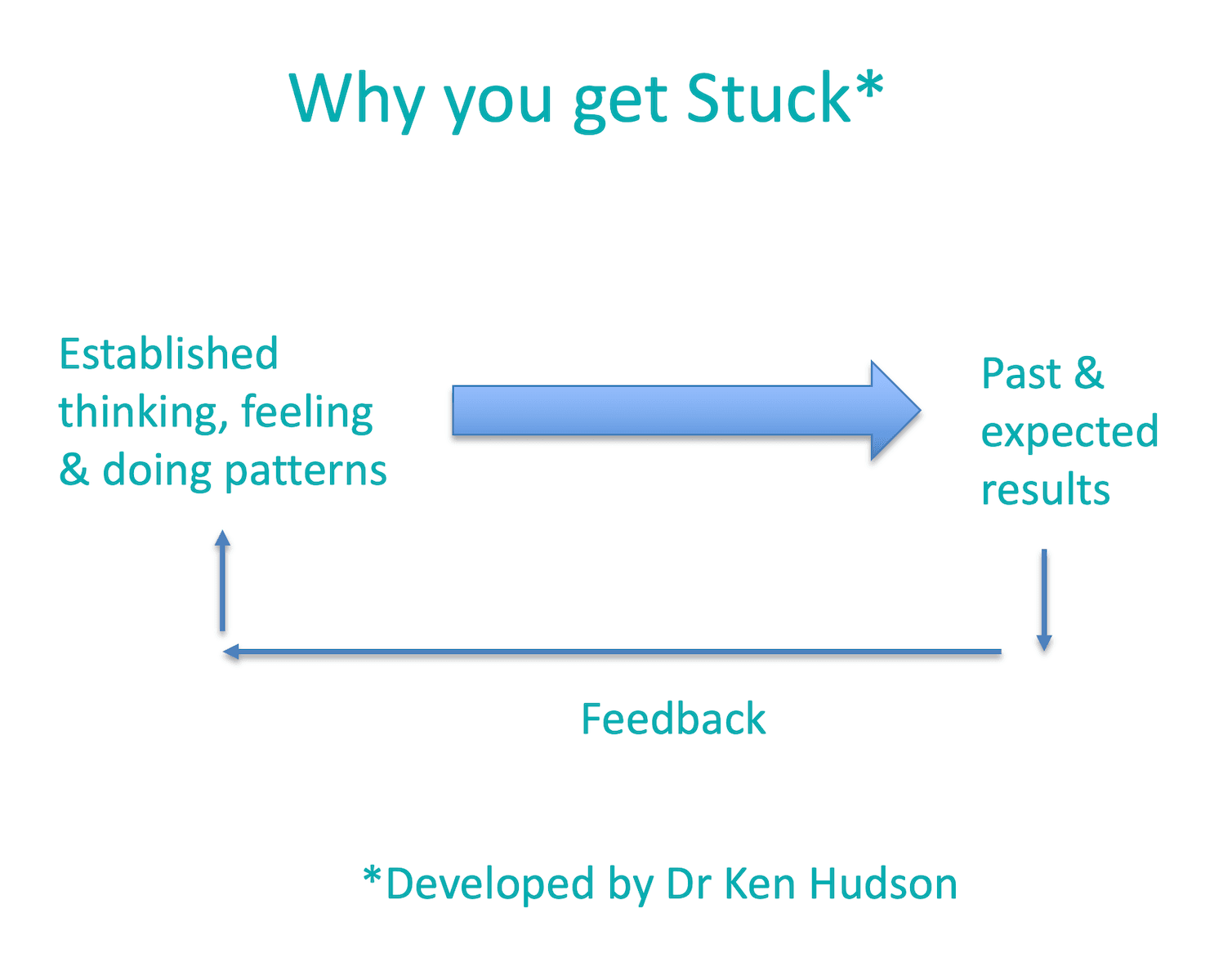
Our Stuck Loop.
Think about this idea.
Your usual, default way of thinking produces a usual response, result or outcome.
And when this happens there is a feedback loop that travels from your outcome back to your thinking.
It becomes a kind of closed loop.
And over time this loop becomes more and more established and dare I say more rigid.
It makes sense however.
You keep doing stuff that works, right.
Why?
Because our brain is incredibly efficient.
It builds patterns — habits of thinking — that help us make quick decisions.
Well yes until there is a change.
Because those same patterns can trap us.
the change could be a change in budget, people, timing, competition moves or consumer demands.
Or an unexpected question in a presentation, meeting or interview.
Then you get stuck in your usual way of thinking.
And in a world which is rapidly changing we are all getting stuck more often.
But what happens when there is a change?
So lets put aside the idea that we get stuck due to a lack of intelligence, experience or say a personality flaw.
It’s because we are thinking in the same way, over and over again.
So when something changes, or a problem doesn’t respond to our usual approach, we often do the opposite of what’s needed:
We double down on the same thinking.
We try harder.
We analyse more.
We push.
But nothing shifts.
We feel stuck.
What People Usually Do (And Why It Falls Short)
When people feel stuck, they often turn to familiar solutions.
1. I’ll just think harder
This is the most common response.
But if your current thinking isn’t working, thinking harder in the same way rarely helps.
It usually leads to overthinking, not insight.
2. I’ll wait for inspiration
Sometimes people step away and hope something will come to them.
And occasionally it does.
This could be an insight in the shower fro example or perhaps when you are out on a walk.
But this approach is:
- unpredictable
- slow
- passive
It doesn’t help when you need a solution right now.
3. Brainstorming or asking others
This can be useful, especially in teams.
But it often:
- takes time
- requires coordination
- produces lots of ideas, not necessarily better ones
It’s not designed for real-time, everyday moments.
4. Using AI tools
AI can generate ideas quickly.
But it still depends on the way you frame the problem
If your thinking is stuck, your prompts often are too.
A Simpler, Faster Way – Switch Thinking
What if the problem isn’t the situation but the way you’re thinking about it?
Switch Thinking is based on a simple idea:
When your current thinking isn’t helping — switch.
Instead of:
- pushing harder
- waiting longer
- analysing more
You make a small, deliberate shift in how you think.
Pause then Switch
When your thinking is not working like it used to – pause.
Then try a switch.
It can be as simple as using one of the 6 Switches:
- Switch your perspective e.g. how would a juggler else see this?
- Switch your focus e.g. what’s working here?
- Switch to imagination e.g. what if we had unlimited funds?
- Switch your emotion e.g. what would this feel like if I were curious instead of frustrated?
- Switch your rules e.g What belief are we still blindly following?
- Switch your questions e.g what’s a scary question?
You can switch in moments.
And by doing so it can changes the direction of your thinking.
You can switch how you think, feel and act – in minutes!
Why It Works
Switch Thinking works because it interrupts your default thinking pattern.
Instead of staying stuck in one mode, you: move to a different way of thinking.
This activates new ideas, new emotions, and new possibilities.
Often, that’s all you need.
Not a complete solution.
Just a shift.
The 2-Minute Advantage
One of the most powerful aspects of Switch Thinking is its simplicity.
You don’t need:
- a workshop
- a long process
- perfect conditions
You just need a moment and a switch.
From Stuck to Unstuck
Being stuck is not a failure.
It’s a signal.
A signal that your current thinking needs to change.
And the good news is:
You don’t need to overhaul everything.
You just need to switch.
Final Thought
Next time you (or your team) feel stuck, don’t ask:
How do I solve this?
Ask:
How can I switch my thinking?
Because sometimes, the fastest way forward is not to push harder but to think differently.